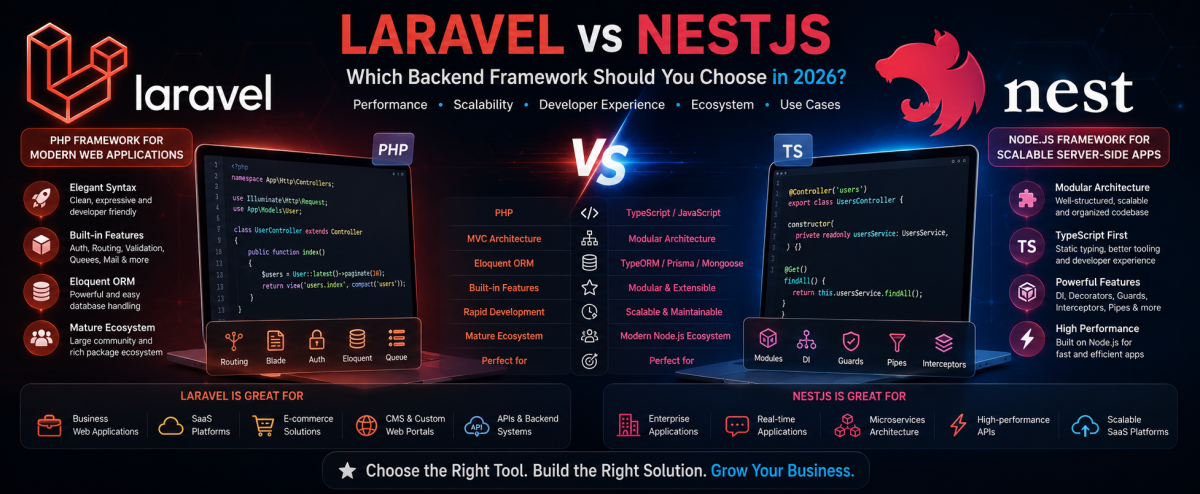
Laravel vs NestJS: Which Backend Framework Should You Choose in 2026?
Choosing the right backend framework is an important decision when building a modern web application.
The backend controls much of an application's core functionality, including business logic, authentication, database communication, APIs, background jobs, integrations, and data processing.
Two technologies that are frequently considered for modern backend development are Laravel and NestJS.
Laravel is a mature PHP framework known for its elegant syntax, powerful ecosystem, built-in features, and developer productivity.
NestJS is a modern Node.js framework built with TypeScript and designed around modular architecture, dependency injection, decorators, and scalable application development.
Both are powerful technologies, but they are designed around different ecosystems and development approaches.
So, which one should you choose?
The answer depends on your project requirements, existing technology stack, team expertise, scalability requirements, development goals, and long-term maintenance strategy.
What Is Laravel?
Laravel is a popular open-source PHP framework designed for building modern web applications and backend systems.
It provides many features out of the box, including:
- Routing
- Authentication
- Authorization
- Database integration
- ORM
- Validation
- Queues
- Events
- Notifications
- File storage
- Caching
- Task scheduling
- API development
- Testing support
Laravel uses the Model-View-Controller (MVC) architectural pattern and provides an extensive ecosystem for application development.
It is particularly popular for business applications, content management systems, APIs, e-commerce platforms, SaaS applications, and custom web software.
What Is NestJS?
NestJS is a Node.js framework designed for building scalable server-side applications.
It is built primarily with TypeScript and uses concepts such as:
- Modules
- Controllers
- Providers
- Dependency injection
- Decorators
- Middleware
- Guards
- Interceptors
- Pipes
- Exception filters
NestJS provides a structured architecture that encourages developers to organize applications into independent modules.
For example, a business application might contain:
- Users Module
- Authentication Module
- Customers Module
- Products Module
- Orders Module
- Payments Module
- Notifications Module
This modular approach can make large applications easier to maintain and extend.
Laravel vs NestJS at a Glance
FeatureLaravelNestJSLanguagePHPTypeScript / JavaScriptRuntimePHPNode.jsArchitectureMVC-orientedModular architectureORMEloquentTypeORM, Prisma, Mongoose and othersAPI DevelopmentExcellentExcellentTypeScriptNot nativeNativeDependency InjectionSupportedCore featureReal-Time ApplicationsSupportedStrong ecosystemBackground JobsBuilt-in queue systemQueue integrationsLearning CurveBeginner-friendlyModerateEcosystemMature PHP ecosystemModern Node.js ecosystemEnterprise ApplicationsExcellentExcellentSaaS DevelopmentExcellentExcellent
Laravel vs NestJS: Programming Language
One of the biggest differences is the programming language.
Laravel uses PHP, while NestJS primarily uses TypeScript.
PHP has been used for web development for decades and has a mature ecosystem.
TypeScript, meanwhile, adds static typing and modern development features to JavaScript.
If your team already works heavily with PHP, Laravel can be a natural choice.
If your organization already uses JavaScript or TypeScript across the frontend and backend, NestJS can provide a more consistent technology stack.
For example:
React + TypeScript + NestJS
allows a team to use TypeScript across the application stack.
Laravel vs NestJS: Architecture
Laravel and NestJS approach application architecture differently.
Laravel provides an MVC-oriented structure with conventions that help developers build applications quickly.
A typical Laravel application may contain:
- Models
- Controllers
- Services
- Requests
- Jobs
- Events
- Policies
- Resources
NestJS focuses heavily on modular architecture.
A typical NestJS application may look like:
Users Module
→ Controller
→ Service
→ Repository
→ Database
Orders Module
→ Controller
→ Service
→ Repository
→ Database
Payments Module
→ Controller
→ Service
→ Payment Provider
This structure can be particularly useful for large applications with many business domains.
Laravel vs NestJS for API Development
Both frameworks are excellent choices for REST API development.
Laravel provides:
- Routing
- Controllers
- Request validation
- API resources
- Authentication
- Database ORM
- Middleware
- Queues
NestJS provides:
- Controllers
- DTOs
- Validation pipes
- Guards
- Interceptors
- Dependency injection
- API documentation integrations
- Modular architecture
For a relatively straightforward API, either framework can work very well.
For highly modular TypeScript-based systems, NestJS can be particularly attractive.
For teams already experienced with PHP and Laravel, Laravel can provide faster development.
Laravel vs NestJS Performance
Performance is often one of the first questions developers ask.
However, framework performance should not be considered in isolation.
Real-world application performance depends on:
- Database queries
- Caching
- Infrastructure
- API design
- Network latency
- External services
- Application architecture
- Background processing
- Code quality
NestJS runs on Node.js, which is well suited to asynchronous and I/O-heavy workloads.
Laravel runs on PHP and can also deliver excellent production performance when properly designed, cached, and deployed.
For most business applications, architecture and implementation quality are likely to have a much larger practical impact than simply choosing one framework over the other.
Laravel vs NestJS for SaaS Development
Both Laravel and NestJS can be used to build SaaS platforms.
A SaaS application may require:
- Authentication
- Organizations
- Multi-tenancy
- Subscription management
- Billing
- User roles
- Permissions
- APIs
- Notifications
- Analytics
- Background jobs
- Integrations
Laravel provides a mature ecosystem for many of these requirements.
NestJS provides a modular architecture that can work particularly well for complex SaaS platforms with multiple independent business modules.
The better choice depends on the team's experience and the architecture required by the product.
Laravel vs NestJS for Database Development
Laravel provides Eloquent, its popular ORM.
Eloquent allows developers to interact with database records using expressive PHP models.
For example, developers can work with relationships such as:
- Users
- Orders
- Products
- Categories
- Payments
NestJS does not force developers to use one particular database solution.
It can work with technologies such as:
- PostgreSQL
- MySQL
- MongoDB
- TypeORM
- Prisma
- Mongoose
This flexibility can be useful when different applications require different database technologies.
Laravel vs NestJS for Authentication
Authentication is essential for almost every modern business application.
Laravel provides a mature authentication ecosystem and supports common approaches for:
- Session authentication
- API authentication
- Token authentication
- Role-based authorization
NestJS provides authentication through its modular architecture and integrations with technologies such as:
- JWT
- Passport
- OAuth
- Custom authentication systems
NestJS guards can also be used to implement authorization rules.
Both frameworks can provide secure authentication when implemented correctly.
Laravel vs NestJS for Background Jobs
Many business applications need to perform tasks outside the main HTTP request.
Examples include:
- Sending emails
- Processing files
- Generating reports
- Importing data
- Sending notifications
- Processing payments
- Generating documents
Laravel provides a built-in queue system that integrates with various queue backends.
NestJS can integrate with queue systems such as Bull and BullMQ.
Both approaches allow long-running operations to be moved into background workers.
Laravel vs NestJS for Real-Time Applications
Real-time functionality is increasingly common in modern applications.
Examples include:
- Live notifications
- Chat applications
- Real-time dashboards
- Delivery tracking
- Collaborative applications
- Live status updates
NestJS benefits from the Node.js ecosystem and provides support for WebSockets and other real-time communication patterns.
Laravel can also support real-time functionality through technologies in its ecosystem.
The appropriate solution depends on the exact requirements and expected traffic.
Laravel vs NestJS Developer Productivity
Laravel is well known for developer productivity.
It provides many common features out of the box, allowing developers to build applications without assembling every component themselves.
NestJS focuses more strongly on structure and modularity.
Developers working with TypeScript may also benefit from:
- Static typing
- Better IDE support
- Type safety
- Reusable interfaces
- Stronger compile-time checks
The fastest framework is therefore often the one your development team already understands well.
Laravel vs NestJS for Enterprise Applications
Both frameworks can be used to build enterprise applications.
Laravel can be an excellent choice when:
- The team has strong PHP expertise
- Rapid business application development is important
- The project benefits from Laravel's ecosystem
- The application follows conventional web architecture
NestJS can be particularly attractive when:
- TypeScript is already widely used
- The application has many independent modules
- The team prefers dependency injection
- The architecture requires strong modular boundaries
- Multiple JavaScript/TypeScript services are involved
Enterprise success depends more on architecture, engineering practices, testing, security, infrastructure, and maintenance than on the framework alone.
Laravel vs NestJS: Which Is Easier to Learn?
Laravel can be easier for developers who are new to backend development because its conventions are straightforward and its ecosystem provides many ready-to-use features.
NestJS may require developers to understand additional concepts such as:
- TypeScript
- Dependency injection
- Decorators
- Modules
- Providers
- Guards
- Interceptors
However, once these concepts are understood, NestJS can provide a highly organized development experience.
The learning curve therefore depends heavily on the developer's existing programming background.
When Should You Choose Laravel?
Laravel may be a strong choice when:
- Your team has PHP expertise.
- You need rapid web application development.
- You want a mature ecosystem.
- You are building a business management application.
- You need a powerful ORM.
- You need queues and scheduled jobs.
- You are building APIs.
- You are developing a SaaS application.
- Your team prefers conventional MVC architecture.
Laravel is particularly strong for business applications where development speed and ecosystem maturity are important.
When Should You Choose NestJS?
NestJS may be a strong choice when:
- Your team uses TypeScript.
- You already have Node.js expertise.
- You want a modular backend architecture.
- You are building complex APIs.
- You need real-time functionality.
- You are building a large SaaS platform.
- You want strong dependency injection patterns.
- Your frontend and backend teams use TypeScript.
- You expect to build multiple Node.js services.
NestJS is particularly attractive for teams that want a structured TypeScript backend architecture.
Can Laravel and NestJS Work Together?
Yes.
Businesses do not necessarily have to choose only one technology.
A system could use Laravel for one part of the application and NestJS for another.
For example:
Laravel → Business Management System
NestJS → Real-Time Service
React / Next.js → Frontend
PostgreSQL / MySQL → Primary Database
Redis → Cache and Queues
However, introducing multiple backend technologies also increases operational and maintenance complexity.
It should therefore be done when there is a clear architectural reason.
Laravel vs NestJS: Which One Is Better?
There is no universal winner.
Choose Laravel if:
You want a mature PHP ecosystem, rapid business application development, powerful built-in functionality, and your team already has Laravel expertise.
Choose NestJS if:
You want a structured TypeScript backend, modular architecture, Node.js ecosystem, and strong integration with modern JavaScript/TypeScript applications.
The best framework is ultimately the one that fits your business requirements, development team, architecture, and long-term maintenance strategy.
Final Thoughts
Laravel and NestJS are both capable frameworks for building modern backend applications.
Laravel provides a mature ecosystem and an efficient development experience for PHP applications.
NestJS provides a modern TypeScript-based architecture with strong modularity, dependency injection, and integration with the Node.js ecosystem.
Instead of choosing a framework because it is currently popular, businesses should evaluate:
- Project requirements
- Team expertise
- Application complexity
- Expected scale
- Integrations
- Security requirements
- Development timeline
- Long-term maintenance
A well-designed application built with the appropriate technology can outperform a poorly designed application built with a theoretically faster or more popular framework.
Architecture matters more than hype.
Build the Right Backend With FusionCentrix
At FusionCentrix, we develop scalable backend systems, REST APIs, SaaS platforms, business applications, integrations, and automation solutions using modern technologies.
Whether your project requires Laravel, NestJS, Node.js, PHP, or a combination of technologies, the focus should always be on choosing the architecture that best supports your business goals.
The right backend framework is not the one with the most features. It is the one that helps you build, scale, and maintain the right product.